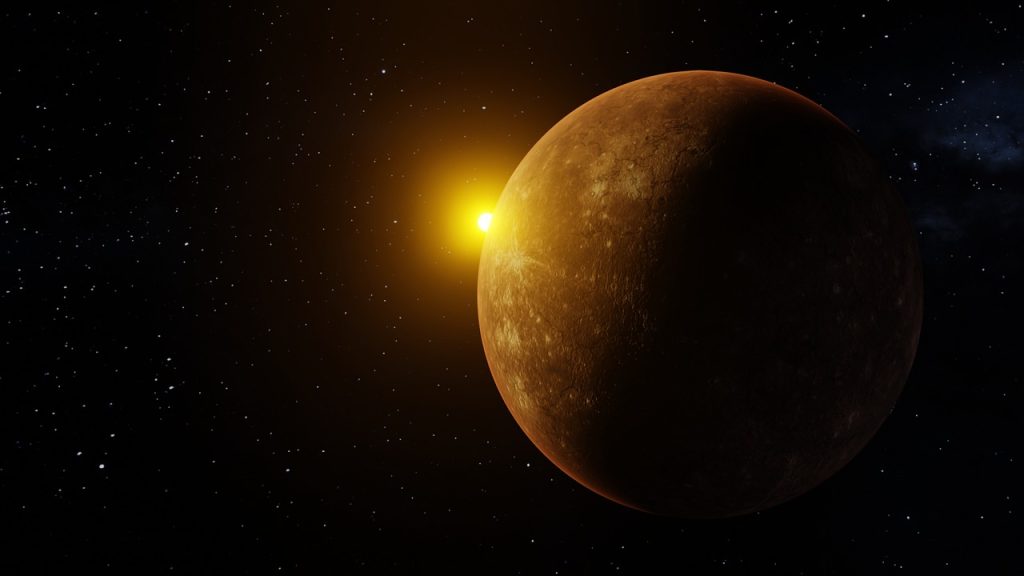
A Planet in our Solar System
Mercury is the innermost and smallest planet in our solar system, only slightly larger than Earth’s Moon. Named after the swift Roman Messenger god, Mercury lives up to its name by being the fastest planet, spinning around the sun every 88 Earth days, giving it the shortest year in the solar system. However, it has a slow rotation, approximately taking 59 Earth days to complete a full rotation, meaning a single solar day (sunrise to next sunrise) lasts a staggering 176 Earth days. Its surface, which lacks any significant atmosphere to stop impacts, is heavily pockmarked with craters, resembling Earth’s Moon. The most notable feature is the Caloris Basin, a massive impact crater about 960 miles wide. This thin atmosphere, or exosphere, also means the planet experiences extreme temperature swings, ranging from a scorching 800°F during the day to a frigid -300°F at night. Curiously, permanently shadowed craters at its poles may even harbor water ice. Beneath its battered surface, Mercury is a dense, rocky planet with an unusually large, iron-rich metallic core that makes up about 85% of its radius. This partially molten core generates a weak magnetic field. Mercury has no moons or rings and spins nearly perfectly upright, so it does not experience seasons. Scientific understanding of Mercury has been greatly enhanced by NASA missions like Mariner 10 and MESSENGER, the latter of which orbited and mapped the planet in detail. Despite its proximity to the Sun, it is not the hottest planet; that title belongs to Venus.